
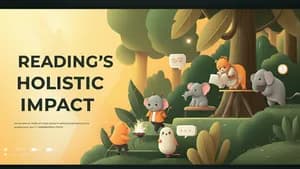
Welcome, students and parents, to a discussion about one of the most powerful, yet often undervalued, aspects of learning: the ability to connect ideas. We often think of reading as a straightforward process – you read the words, you understand the meaning, and you're done. But what if I told you that the true magic of reading lies not just in comprehending what's on the page, but in what happens between the pages, between the subjects, and between the diverse thoughts you encounter? Reading across various subjects and genres trains the mind to identify connections, synthesize disparate information, and form coherent conclusions. This skill is not merely academic; it is paramount for complex problem-solving in the real world and for forming a truly comprehensive understanding of any topic, big or small. In my many years working with learners of all ages, I have consistently observed that those who master this art of 'connecting the dots' are the ones who not only excel academically but also become the most adaptable, innovative, and insightful individuals.
Think of your brain not as a series of separate compartments for each subject—history here, science there, literature somewhere else—but as a vast, intricate web. Every new piece of information is a node, and the act of connecting ideas is like weaving new threads between these nodes. The more connections you make, the stronger, more resilient, and more flexible your understanding becomes. This isn't about memorizing more facts; it's about seeing the grand tapestry of knowledge, understanding how different elements interact, and predicting how they might behave. It’s about moving beyond simply knowing what happened to understanding why it happened, how it connects to other events, and what its implications might be for the future. This holistic approach to reading transforms passive consumption of information into an active, dynamic process of knowledge creation within your own mind.
Beyond the Pages: Cultivating Curiosity and Broadening Horizons
The first step to becoming a master connector of ideas is to cultivate a deep and genuine curiosity that extends beyond the confines of a single textbook or syllabus. When you limit your reading to only what's required for a specific class, you inadvertently limit the mental playground where connections can be made. Imagine if an artist only used one color; their masterpiece would lack depth and nuance. Similarly, your intellectual masterpiece requires a full spectrum of ideas.
Encourage yourself, or your student, to read widely—not just within academic disciplines, but across genres. Pick up a historical fiction novel after reading a history textbook. Explore a science fiction story that grapples with ethical dilemmas after a philosophy lesson. Read a biography of an inventor and then research the economic conditions that fueled their innovations. For instance, when I was guiding a student through a project on the Industrial Revolution, we didn't just stick to the history books. We explored Dickens' novels to understand the social impact, read simplified explanations of steam engine mechanics to grasp the scientific leaps, and even looked at maps to understand the geographical factors influencing factory placement. This multi-faceted approach provided a richness of understanding that a single-subject focus could never achieve. It showed the student that history isn't just dates and names; it's a complex interplay of human ingenuity, social change, and environmental factors.
This broad reading habit isn't about becoming an expert in every field, but rather about exposing your mind to diverse vocabularies, different modes of thinking, and a variety of perspectives. It's about developing mental flexibility. When you encounter a new concept in biology, for example, having read about systems theory in sociology or complex adaptive systems in economics can provide a powerful analogous framework for understanding biological ecosystems. Similarly, understanding the narrative structures in literature can help you discern patterns in historical events or even in the way scientific discoveries unfold. This diverse intellectual diet strengthens your cognitive muscles, preparing them to seek out and build bridges between seemingly unrelated pieces of information. It teaches you that every piece of knowledge, no matter how specialized, exists within a larger context, and understanding that context is key to true mastery.
The Architect's Blueprint: Identifying Patterns and Commonalities
Once you begin to read broadly, the next crucial step is to actively seek out patterns and commonalities. This isn't something that happens automatically; it requires an intentional shift in how you engage with text. Instead of simply absorbing information, you become an active investigator, searching for recurring themes, underlying principles, and analogous structures across different domains.
Consider the concept of cause and effect. You learn about it in history when studying revolutions, in science when analyzing experiments, and in literature when dissecting plot developments. The underlying principle is the same, even if the specific manifestations differ. Or think about problem-solving methodologies: the scientific method isn't exclusive to laboratories; its systematic approach to observation, hypothesis, experimentation, and conclusion can be applied to solving a business challenge, navigating a personal dilemma, or even designing a social program. When you read, ask yourself: