
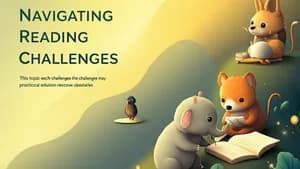

Play is often perceived as mere recreation, yet for young children, it is the fundamental pathway to learning and development. In the realm of early literacy, play-based learning emerges as a powerful, intuitive, and highly effective approach, particularly when addressing the common reading challenges faced by young minds. By integrating learning into engaging, child-led activities, educators and parents can transform potential struggles into opportunities for joyful discovery and mastery.
Understanding Early Reading Challenges
The journey to literacy is complex, and many young children encounter hurdles along the way. These can manifest as difficulties with phonological awareness (the ability to recognize and manipulate the sounds of language), limited vocabulary, struggles with print awareness (understanding that print carries meaning), or a lack of motivation due to early negative experiences. For a child, these challenges can be disheartening, leading to anxiety and a reluctance to engage with reading. Traditional, highly structured approaches, while having their place, can sometimes exacerbate these feelings, making the learning process feel like a chore rather than an adventure.
The Power of Play in Fostering Literacy
Play-based learning offers a refreshing alternative, leveraging children's natural curiosity and desire to explore. It provides a low-pressure environment where mistakes are part of the learning process, and engagement is intrinsically motivated.
Building Phonological Awareness and Phonics Through Play
Phonological awareness is a cornerstone of reading, enabling children to hear, identify, and manipulate individual sounds (phonemes) in spoken words. Play offers countless avenues to develop this skill:
- Rhyming Games: Singing rhyming songs, reading rhyming books, or playing "I Spy" with rhyming words (e.g., "I spy something that rhymes with 'cat'").
- Sound Hunts: Searching for objects around the room that start with a specific sound.
- Segmenting and Blending: Using blocks or toys to represent sounds in a word, then pushing them together to "blend" the word or pulling them apart to "segment" it.
- Alliteration Fun: Creating silly sentences with words that start with the same sound.
These activities make abstract sound concepts tangible and fun, laying a strong foundation for decoding and encoding.
Expanding Vocabulary and Comprehension Through Imaginative Play
A rich vocabulary is crucial for reading comprehension. Play provides a natural context for children to encounter and internalize new words, as well as develop narrative skills essential for understanding stories.
- Role-Playing and Dramatic Play: Pretending to be doctors, chefs, or astronauts introduces specific vocabulary related to those roles. Children learn to use words in context, enhancing their understanding and recall.
- Storytelling with Puppets or Props: Creating narratives together encourages children to use descriptive language, sequence events, and develop characters, all of which strengthen comprehension skills.
- Open-Ended Questions: During play, asking "What do you think will happen next?" or "Why did the character do that?" encourages critical thinking and deeper understanding.
Through these interactions, children not only learn new words but also develop the ability to construct meaning from language, a vital skill for reading.
Cultivating Print Awareness and Motivation
Print awareness is the understanding that written language represents spoken language and carries meaning. Play can demystify print and foster a positive attitude towards it.
- Environmental Print: Pointing out and reading labels on cereal boxes, street signs, or store names during everyday outings.
- Creating Signs and Labels: In a pretend play scenario (e.g., a grocery store or a vet clinic), children can create signs, price tags, or appointment cards, seeing print as a functional tool.
- Writing Letters and Cards: Encouraging children to "write" letters or draw pictures for family and friends, even if it's just scribbles, connects the act of writing with communication.
These activities demonstrate the purpose and power of print in a meaningful, non-threatening way, sparking curiosity and motivation to learn to read.
Developing Fine Motor Skills for Pre-Writing
While not directly reading, fine motor skills are essential for the physical act of writing, which is intrinsically linked to literacy development. Play naturally strengthens these muscles.
- Drawing and Scribbling: Encouraging artistic expression with crayons, markers, and paint.
- Manipulating Playdough: Rolling, squeezing, and cutting playdough strengthens hand muscles.
- Building with Blocks and Legos: Stacking and connecting small objects improves hand-eye coordination and dexterity.
- Cutting with Scissors: Practicing cutting shapes and lines.
These playful activities build the necessary hand strength and coordination required for holding a pencil and forming letters, preparing children for the writing component of literacy.
Implementing Play-Based Literacy Strategies

For educators, creating literacy-rich play environments is key. This involves integrating books, writing materials, and print into various play centers. Observing children during play allows for targeted scaffolding, where an adult can gently guide, ask questions, or introduce new vocabulary at opportune moments. For parents, incorporating play-based literacy into daily routines can be as simple as reading aloud, engaging in playful conversations, or making a game out of identifying letters and sounds in the environment. The focus should always be on making learning enjoyable and child-centered.
Beyond Reading: Holistic Development
The benefits of play-based learning extend far beyond literacy. It nurtures creativity, problem-solving skills, social-emotional development, and critical thinking. Children learn to collaborate, negotiate, and express themselves, all of which indirectly support their ability to engage with and comprehend written material. By fostering a love for learning and building confidence, play-based approaches create resilient learners who are better equipped to navigate all academic challenges.
Conclusion
Play-based learning is not merely a supplementary activity; it is a foundational pedagogical approach that powerfully addresses early reading challenges for young minds. By embracing children's natural inclination to play, we can create dynamic, engaging, and effective learning environments that build essential literacy skills, foster a lifelong love of reading, and support holistic development. For every child, the path to literacy can and should be an exciting adventure, guided by the joy and freedom of play.